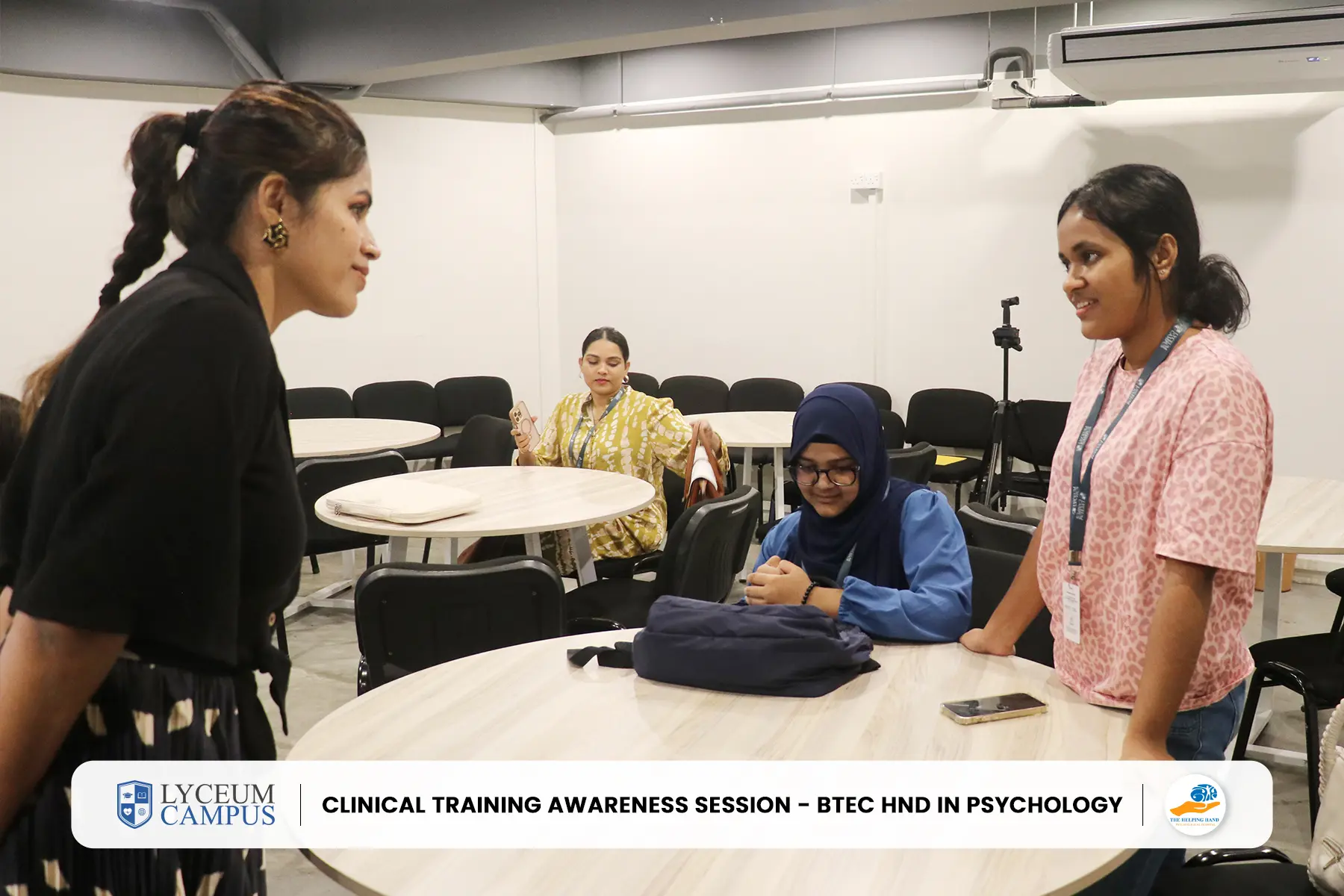
What the field actually involves, the career paths it opens, and what to look for in a genuine qualification
For a long time, psychology sat awkwardly in the list of subjects Sri Lankan students considered after school. It wasn't seen as a "safe" choice the way medicine, engineering, or business were, and a common worry among both students and parents was a simple one: what does someone actually do with a psychology qualification once they have it? That question is worth answering properly, because the honest answer today is genuinely encouraging, provided you understand what the field involves and choose a qualification that leads somewhere real.
Why Psychology is Becoming So Relevant in Sri Lanka Right Now
Mental health has moved from a subject nobody discussed to one that workplaces, schools, and families are actively trying to address, and the country's capacity to respond hasn't caught up with that shift. According to World Health Organization data cited by the ILO and IFC's Better Work Sri Lanka programme, the country has only around 0.03 psychologists and 0.6 psychiatrists per 100,000 people, a strikingly small number set against a population of roughly 21 million. Separately, licensing data compiled for 2025 shows only around 80 clinical psychologists registered with the Sri Lanka Medical Council nationwide. Put simply: the demand for trained people who understand human behaviour, mental wellbeing, and counselling support is real and growing, while the supply of qualified professionals remains thin. That gap is exactly why psychology, once viewed as a niche interest, is increasingly being taken seriously as a genuine career field.
What Studying Psychology Actually Involves
Psychology isn't simply "talking to people" or offering advice based on intuition, and that's often the biggest misconception students walk in with. At its core, it's the scientific study of behaviour, cognition, and emotion, and a properly structured programme will cover areas such as theoretical models of the mind, ethical frameworks for working with vulnerable people, research methods, developmental and social psychology, and, in more applied and counselling-focused programmes, direct skills training in how to build a therapeutic relationship, communicate empathically, and work with different types of clients. A good programme balances this academic grounding with genuine, supervised practical experience, not just lecture-based theory.
Career Paths a Psychology-Related Qualification Can Open
One of the most common misunderstandings is that a psychology qualification only leads to one job title: "psychologist." In reality, the skill set it builds, understanding people, communicating with empathy, and applying structured thinking to human behaviour, is transferable across a wide range of careers.
- Counselling: Supporting individuals through emotional, relational, or behavioural difficulties, often in private practice, schools, or community organisations
- Clinical Psychology: Diagnosing and treating mental health conditions in clinical settings; requires postgraduate specialisation and SLMC registration in Sri Lanka
- Human Resources and Organisational Psychology: Applying behavioural science to recruitment, employee wellbeing, workplace culture, and performance management
- Education and Special Needs Support: Working with schools and students on learning difficulties, behavioural support, and child development
- Research and Academia: Studying human behaviour, cognition, and social dynamics through formal research, often progressing toward postgraduate study
- UX and Human Factors: Applying an understanding of human behaviour and decision-making to product design, technology, and user research roles
An Important Distinction: Counselling, Psychology, and Regulation in Sri Lanka
This is the part most students and parents don't get told clearly enough, and it matters a great deal when choosing a course. In Sri Lanka, clinical psychologists are formally regulated by the Sri Lanka Medical Council, which requires a specialised postgraduate qualification, such as a two-year MPhil in Clinical Psychology, along with a minimum of 1,500 hours of supervised clinical training under a registered clinical psychologist before someone can practise and register under that title. General psychologists and counsellors, by contrast, currently practise in a largely unregulated field in Sri Lanka, meaning the title alone doesn't guarantee a consistent standard of training.
This isn't a reason to avoid the field. It's a reason to be deliberate about which qualification you choose, and to understand it as a starting point rather than an end point. A well-recognised undergraduate-level qualification in counselling and applied psychology is genuinely valuable, both as a standalone foundation for roles in support work, education, HR, and community mental health, and as the first academic step toward postgraduate clinical training later, for those who want to pursue formal clinical psychology registration down the line.
What to Look for in a Psychology or Counselling Programme
- Who awards the qualification, and is that awarding body internationally recognised and independently verifiable, rather than just locally marketed?
- Does the course include genuine, supervised practical experience in real counselling or support settings, not only classroom theory?
- What is the exact module structure, and does it cover ethics, diverse client populations, and evidence-based approaches such as cognitive behavioural methods?
- What does the qualification lead to afterward: a degree top-up, direct employment, or further postgraduate study, and is that progression documented rather than vague?
- What are the entry requirements, and is there a genuine alternative route for students who don't meet them directly?
- If the eventual goal is to become a licensed clinical psychologist, does the institution clearly explain the postgraduate and supervised-hours requirements involved, rather than implying the undergraduate qualification alone is sufficient?
A Real Example: The BTEC HND in Counselling and Applied Psychology
It helps to look at what a properly structured programme in this field actually looks like in practice. The
Pearson BTEC Higher National Diploma in Counselling and Applied Psychology, offered at
Lyceum Campus in Nugegoda, is a UK-awarded qualification delivered over 18 months, with intakes in March and September, aimed at students entering with two A/Level passes (or a recognised foundation qualification) and a B pass in O/Level English. The module structure covers ethical frameworks in counselling, empathic communication, cognitive behavioural approaches, working with diverse clients, counselling young people, and a dedicated research module, alongside personal and professional development. On successful completion, it allows progression into the final year (top-up) of a UK bachelor's degree, and merit-based scholarships tied to A/Level results are available.
What makes this a useful reference point isn't the institution itself, but the structure: a named UK awarding body, a clear 18-month timeline, explicit entry requirements, a documented list of modules that includes both theory and applied counselling skills, and a defined next step (the bachelor's degree top-up) rather than a vague promise of "further study." That level of detail is what separates a genuine qualification from one that simply uses "psychology" as an attractive course title.
The Honest Challenges Worth Knowing About
Psychology is a rewarding field, but it's fair to be upfront about the parts that are genuinely demanding. Reaching full clinical psychologist registration in Sri Lanka takes years beyond an undergraduate qualification, including postgraduate study and supervised clinical hours, so students aiming specifically for that title need to plan for a longer academic path. Because general counselling and psychology roles remain largely unregulated locally, the burden of choosing a credible, well-taught qualification falls more heavily on the student than it would in a tightly regulated field like medicine or law. The work itself, particularly in counselling and mental health support roles, can also be emotionally demanding, and it suits people who are genuinely comfortable sitting with other people's difficulties, not just those who enjoy the subject academically. None of this makes the field a poor choice; it simply means going in with realistic expectations about the time, structure, and emotional resilience it asks for.
Final Thoughts
Psychology has moved well past being seen as an uncertain or "soft" choice. Sri Lanka has a documented, significant shortage of trained mental health and behavioural science professionals, and the demand for people who genuinely understand human behaviour now stretches across counselling, education, human resources, research, and increasingly, technology and design. What determines whether a psychology qualification turns into a solid career isn't the subject itself, it's the credibility of the specific course: a recognised awarding body, real supervised practice, a transparent progression pathway, and honesty about what further study is required for roles like clinical psychology. Choose on those terms, and psychology stands up as one of the more genuinely future-relevant fields a student in Sri Lanka can study today.